
Cellular changes
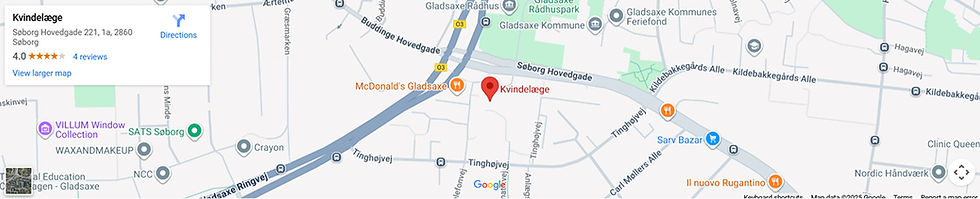
Søborg Hovedgade 221, 1a, 2860 Søborg
Telephone appointment: 39 67 09 39
Monday - Thursday 09:00 - 11:00
CONTACT

GYNECOLOGIST
© 2025 Specialist Lise Helmsøe-Zinck.
All rights reserved.

Specialist
Lise Helmsøe-Zinck


Treatment of cell changes on the cervix and endometrium
The cervical smear test you have had suggests cell changes.
Such cell changes are not cancer, and almost all women who are diagnosed with cell changes are completely cured. The cell changes occur due to an infection with a virus called human papillomavirus (HPV). Both the viral infection and the cell changes are usually asymptomatic. However, it is known that cell changes left untreated over time can develop into cervical cancer, which is why we would recommend that you have further examinations and possibly treatment. We will therefore offer you a visual examination of the cervix (colposcopy), combined with small tissue samples (biopsies) and a small scraping (cervixabrasion) from the cervix. After 1 week, we will have the results of the tissue samples and will then know the degree of cell changes and whether there is a reason for treatment. The cell changes or precursors, as they are also called, are divided according to how pronounced they are when examined under a microscope. We speak of mild, moderate and severe changes or carcinoma in situ.
What are cell changes?
Treatment
If there are mild and in some cases moderate changes, a check-up after 6 months will initially be sufficient. For more pronounced changes, we would recommend treatment in the form of a cone operation. In most cases, the procedure can be performed on an outpatient basis under local anesthesia. With a small electric loop, a small cone-shaped piece of tissue is cut out, including the cell changes on the cervix. The procedure itself takes about 15 minutes. After the procedure, you must wait about ½ hour to ensure that there is no bleeding. There will usually be no pain, but if it does occur, you can buy over-the-counter medication, such as Panodil.
After the procedure, you should take it easy for a few days and avoid running and cycling. If you have heavy work, we recommend taking 3-4 days off work. There will be light bleeding and discharge for 2-3 weeks after the procedure, and during that period you should avoid intercourse, swimming, baths and moderate physical activity. After 3-5 weeks, the cervix has healed, and new mucous membrane covers the area from which the cone was removed. The procedure has no effect on sexual intercourse or your chances of getting pregnant and carrying a pregnancy to term.
The microscopic examination describes the degree of cell changes. Since the cone is removed with electrosurgery, it will often be relatively difficult to assess the edges. Even if the changes reach the edge, further treatment is rarely necessary. The first 2 checks are carried out here approx. 6 months and 12 months after the procedure, regardless of whether the edges are free. In a few cases, it will be advisable to have slightly more frequent checks. After the checks, you move on to regular screening with your GP.
PDF form: Cellular changes (PDF)
Control
Cellular changes
Treatment of cell changes on the cervix and endometrium
What are cell changes?
The cervical smear test you have had suggests cell changes.
Such cell changes are not cancer, and almost all women who are diagnosed with cell changes are completely cured. The cell changes occur due to an infection with a virus called human papillomavirus (HPV). Both the viral infection and the cell changes are usually asymptomatic. However, it is known that cell changes left untreated over time can develop into cervical cancer, which is why we would recommend that you have further examinations and possibly treatment. We will therefore offer you a visual examination of the cervix (colposcopy), combined with small tissue samples (biopsies) and a small scraping (cervixabrasion) from the cervix. After 1 week, we will have the results of the tissue samples and will then know the degree of cell changes and whether there is a reason for treatment. The cell changes or precursors, as they are also called, are divided according to how pronounced they are when examined under a microscope. We speak of mild, moderate and severe changes or carcinoma in situ.
Treatment
If there are mild and in some cases moderate changes, a check-up after 6 months will initially be sufficient. For more pronounced changes, we would recommend treatment in the form of a cone operation. In most cases, the procedure can be performed on an outpatient basis under local anesthesia. With a small electric loop, a small cone-shaped piece of tissue is cut out, including the cell changes on the cervix. The procedure itself takes about 15 minutes. After the procedure, you must wait about ½ hour to ensure that there is no bleeding. There will usually be no pain, but if it does occur, you can buy over-the-counter medication, such as Panodil.
After the procedure, you should take it easy for a few days and avoid running and cycling. If you have heavy work, we recommend taking 3-4 days off work. There will be light bleeding and discharge for 2-3 weeks after the procedure, and during that period you should avoid intercourse, swimming, baths and moderate physical activity. After 3-5 weeks, the cervix has healed, and new mucous membrane covers the area from which the cone was removed. The procedure has no effect on sexual intercourse or your chances of getting pregnant and carrying a pregnancy to term.
Control
The microscopic examination describes the degree of cell changes. Since the cone is removed with electrosurgery, it will often be relatively difficult to assess the edges. Even if the changes reach the edge, further treatment is rarely necessary. The first 2 checks are carried out here approx. 6 months and 12 months after the procedure, regardless of whether the edges are free. In a few cases, it will be advisable to have slightly more frequent checks. After the checks, you move on to regular screening with your GP.
PDF form: Cellular changes (PDF)
